
Douglas Fairbanks
Silent film star known as 'The King of Hollywood'.

Wikipedia / Wikimedia Commons
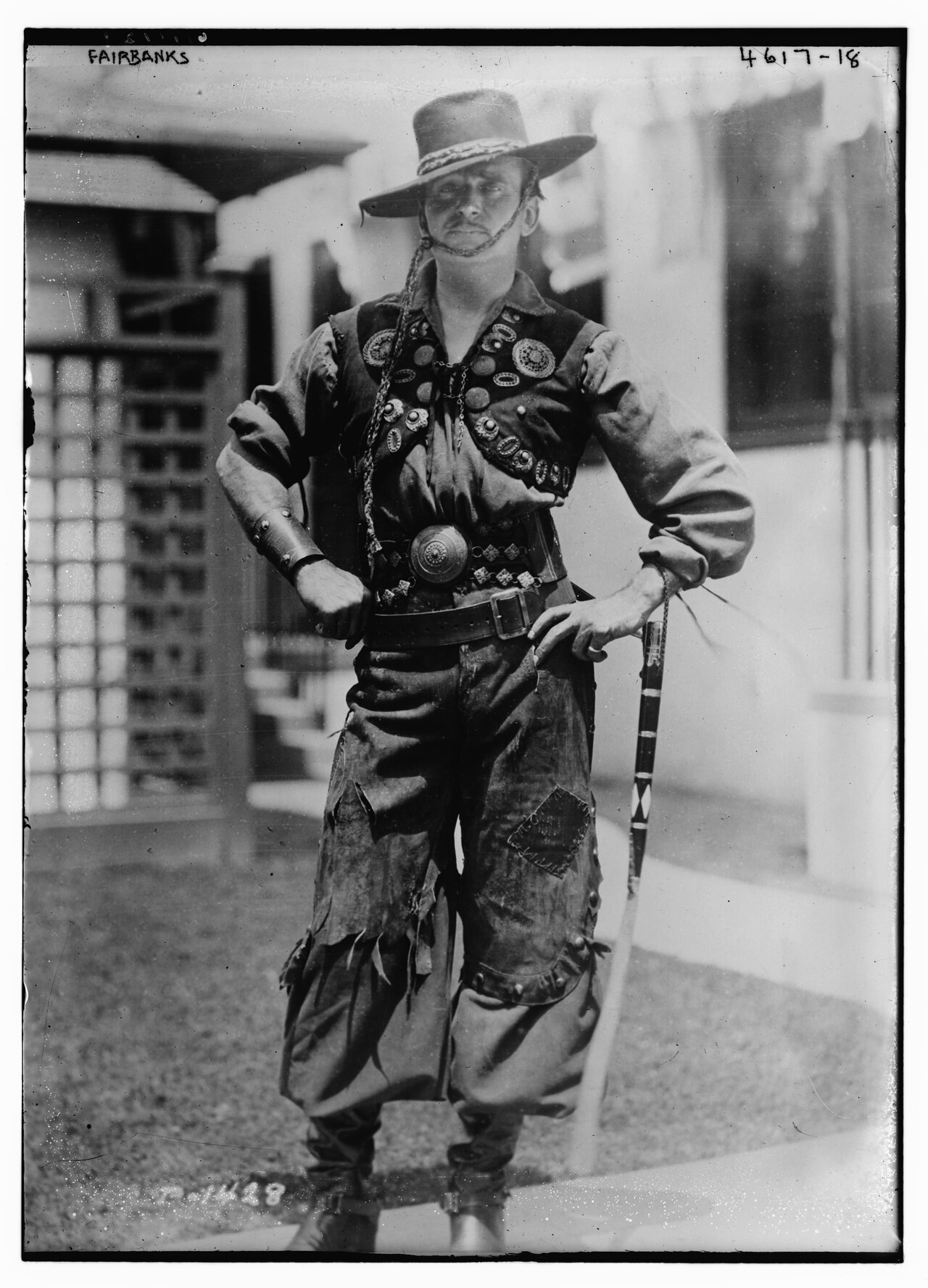
Douglas Elton Fairbanks Sr., born Douglas Elton Thomas Ullman on May 23, 1883, in Denver, Colorado, was an American actor and filmmaker. He is remembered as the first person to portray the masked vigilante Zorro on screen, along with other swashbuckling roles in silent films. A major star of the silent era, he earned the nickname "The King of Hollywood." Fairbanks helped found both United Artists and the Motion Picture Academy, and he served as host for the first Academy Awards ceremony in 1929. He died on December 12, 1939, at age 56.
- born
- May 23, 1883, Denver, Colorado
- died
- December 12, 1939, age 56
- field
- Actor, filmmaker
- nationality
- American
- known_for
- First actor to play Zorro; swashbuckling silent films; co-founder of United Artists and the Motion Picture Academy
Lore & Background
Fairbanks began acting in amateur theatre in Denver and later found Broadway roles. He made his film debut in 1915 and quickly became one of the most popular and highest paid actors in Hollywood. In 1919, he co-founded United Artists alongside Charlie Chaplin, Mary Pickford and D. W. Griffith. Fairbanks married Pickford in 1920 and the couple came to be regarded as 'Hollywood royalty'. Primarily a comedic actor early in his career, he moved into the adventure genre with the 1920 film The Mark of Zorro and found further success in films including Robin Hood (1922) and The Thief of Bagdad (1924).
Fairbanks' career rapidly declined with the advent of the 'talkies' in the late 1920s. His final film was The Private Life of Don Juan (1934), after which he retired from acting but continued to be marginally involved in the film industry and United Artists. He died in 1939 at the age of 56. Fairbanks was a Freemason, having been initiated at Beverly Hills Lodge No. 528.
Reader's Guide
Douglas Fairbanks was a central figure in the silent film era, both as a performer and as a business innovator. His athletic, swashbuckling roles in films such as The Mark of Zorro, Robin Hood, and The Thief of Bagdad set the standard for the adventure genre and made him an international icon. As a co-founder of United Artists, he helped actors gain greater control over their work and profits, challenging the studio system. He also served as the first president of the Motion Picture Academy and hosted the first Academy Awards ceremony. His marriage to Mary Pickford created a celebrated partnership known as 'Hollywood royalty'. However, the transition to sound films ended his starring career, and his final film was released in 1934. Fairbanks's legacy endures as a pioneer of the swashbuckling film and a key architect of Hollywood's independent production model.
Did You Know?
- Fairbanks was born Douglas Elton Thomas Ullman in Denver, Colorado.
- He was a founding member of United Artists alongside Charlie Chaplin, Mary Pickford, and D. W. Griffith.
- He hosted the 1st Academy Awards in 1929.
- His final film was The Private Life of Don Juan (1934).
From Child Star to Leading Man
In the summer of 1923, a thirteen-year-old Douglas Fairbanks Jr. arrived in Hollywood to a crowd of fans, having been signed to a three-year, thousand-dollar-a-week deal with Paramount Pictures largely on the strength of his father's name. Jesse L. Lasky, the studio executive who signed him, declared the boy the typical American boy at his best and floated a Tom Sawyer picture that never came to fruition. Instead, the young actor landed in Stephen Steps Out, which failed at the box office. His father had objected to the arrangement, insisting the boy should continue his education rather than work at thirteen. By mutual consent the contract ended, and the young man went to Paris to resume his studies. A year later he returned to Paramount not as a star but as a camera assistant earning what he later described as starvation wages. In a 1928 interview he explained his philosophy: he wanted to build his acting career slowly and painstakingly rather than simply riding his looks. That patience bore fruit. A borrowed role in Sam Goldwyn's Stella Dallas became his first box-office success, and a 1927 stage debut in Young Woodley earned excellent reviews that reshaped how Hollywood perceived him.
The Swashbuckler's Heir
Douglas Fairbanks Jr. grew up in the shadow of a father who had become one of cinema's earliest global icons through swashbuckling epics like The Mark of Zorro, Robin Hood, and The Thief of Bagdad. The younger Fairbanks first appeared in small roles in two of those very films—American Aristocracy in 1916 and The Three Musketeers in 1921—absorbing the physical style from the inside. As he matured into a leading man during Hollywood's Golden Age, he picked up his father's swashbuckling approach and applied it to a string of adventure pictures that defined his screen persona. The Prisoner of Zenda (1937), Gunga Din (1939), and The Corsian Brothers (1941) showcased his ability to carry a film with physical energy and charm. Beyond the screen, that same dash carried him into high society and royal circles, where he became a recognizable figure. His career also included a notable supporting turn in Little Caesar (1931) alongside Edward G. Robinson, a film he later recalled as one the cast sensed would become a classic during production. Warner Bros. rewarded his work with a contract that included cast and script approval, a privilege he noted was extended to only one other actor at the studio, Richard Barthelmess.
Decorated Officer of the Beach Jumpers
When the Second World War called, Douglas Fairbanks Jr. set aside his Hollywood career to serve as a United States Navy officer. His wartime role was far from administrative: he oversaw the Beach Jumpers, a special warfare unit. The work earned him a string of military decorations reflecting the breadth of his service across multiple allied nations. Among the accolades he received were the Silver Star and the Legion of Merit from the United States, the French Legion of Honour and Croix de Guerre, and the British Distinguished Service Cross. For a man who had spent the 1930s as a leading man in swashbuckling adventures, the transition to military command represented a dramatic shift in how the public understood him. His service connected him to international military circles, as evidenced by the fact that both France and Britain saw fit to honor him with their respective decorations. After the war, he returned to civilian life. His first marriage was to actress Joan Crawford, and he continued to cut a dash in high society and royal circles, where his family name and personal reputation opened doors that few could match.
A Life Shaped by Privilege and Restlessness
Born in New York City in 1909, Douglas Elton Fairbanks Jr. was the only child of the legendary screen actor and Anna Beth Sully, daughter of wealthy industrialist Daniel J. Sully. His childhood was marked by constant geographic movement: after his parents divorced when he was nine, he lived with his mother in New York, California, Paris, and London. His education reflected that restlessness. He attended the exclusive Hollywood School for Boys in Los Angeles, then the Bovee School in New York, where he also spent a year in the drum corps of the Knickerbocker Greys drill academy. Back in California he went to Harvard Military School and the Polytechnic School in Pasadena, and in France he studied at Lycée Janson-de-Sailly. This peripatetic upbringing gave him a cosmopolitan ease that later served him well in royal and high-society circles. His personal life was equally storied. He became romantically involved with actress Joan Crawford after she attended his stage production of Young Woodley as a regular audience member, and the two later married. His stepmother was Mary Pickford, another pillar of early cinema, placing him at the intersection of the industry's most iconic families.
Gallery

More in Screen Legends 25-30
Elsewhere in the Screen Legends universe
Spotted an error? Know more?
This is a living reference — every entry is fact-audited, and reader corrections feed straight into our audit queue. Suggest an edit · See this site's audit record